
What Is a Miswak Stick? The Tree Behind the Tradition

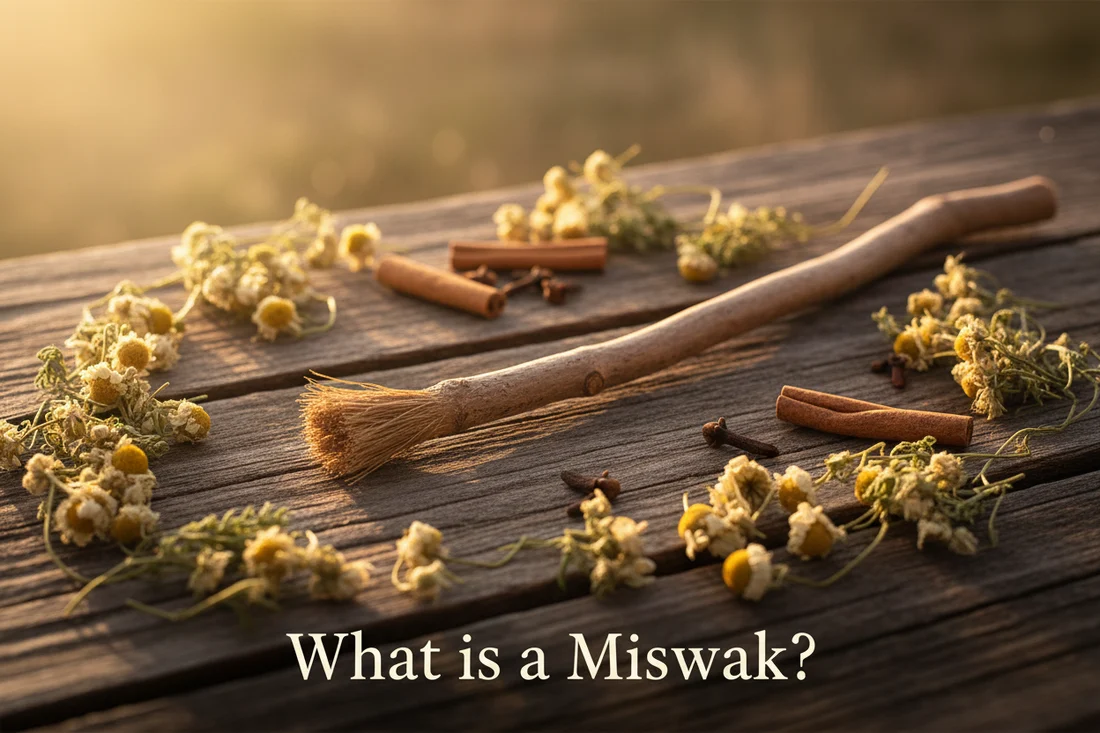
You have probably seen one. A short, pale twig with a frayed tip, tucked into a jacket pocket or sold at the till of your local halal shop. It looks humble. It has been cleaning teeth for thousands of years.
So what is a miswak stick, and why does a small shrub from the desert still matter to your morning routine in Britain? Start with the tree.
What Is a Miswak Stick, Exactly?
A miswak is a natural tooth cleaning stick cut from the roots, twigs or stem of a shrub called Salvadora persica. The word is Arabic. It simply means “tooth cleaning stick.”
You peel back the bark at one end. You chew the exposed wood until the fibres soften and separate. Those fibres become your bristles. When they wear down, you trim the tip and start again. One stick lasts for weeks.
Researchers sum it up neatly. The miswak cleans in two ways at once: mechanically, through its fibres, and chemically, through the compounds it releases as you use it.
What Is Miswak Stick Called Around the World?
The same stick carries many names:
- Siwak, miswaak, sewak across Arabic speaking regions
- Misvak in Turkish and Persian
- Koyoji in Japanese
- Qesam in Hebrew
- Sothiou in the Wolof language of Senegal
- Arak, after the tree itself
Different words. One idea. Clean teeth with a plant.
The Tree Behind the Tradition: Meet Salvadora persica
Salvadora persica goes by a fitting English name: the toothbrush tree. Many people know it as the Arak tree.
It is a tough little evergreen. It rarely grows taller than three metres. Its trunk twists. Its leaves are small, thick and fleshy, and they smell sharply of mustard or cress. Its tiny berries are edible, fresh or dried.
What makes it remarkable is where it survives. Bone dry plains. Salty soils. Coastal scrub. Desert flood plains. Savannah. Conditions that would kill most shrubs barely trouble it.
Its range is vast. It grows from Mauritania in West Africa across Sudan, Ethiopia and down to southwestern Africa. It spreads east through Egypt, the Arabian Peninsula, Iraq, Iran and Pakistan, and on into India, Nepal and Sri Lanka.
Scientists have identified at least 182 plant species people use as tooth cleaning sticks. Salvadora persica is the most widely used of them all.
Why Do People Call It an African Toothbrush Stick?
Search for African toothbrush sticks and you will land on the miswak again and again. There is good reason.
Chewing sticks have deep roots across the continent. Western travellers described men and women in the Sahara and Sudan cleaning their teeth with them whenever they sat down to socialise. In Kenya, Ghana, Nigeria, Zanzibar and Senegal, the habit has run through generations.
Much of the early research on miswak came from Africa too:
- In Sudan, a study of 213 men found miswak users had better periodontal health than toothbrush users.
- In Ghana, chewing stick users showed low rates of decay despite a carbohydrate rich diet.
- In Zanzibar, rural communities where miswak use was common had fewer cavities than urban areas.
- In Kenya’s Kaisut Desert, serious decay and advanced gum disease were rare among miswak users under 50.
So when someone calls it an African stick toothbrush, they are not wrong. They are just describing one branch of a much wider family tree.
Is Every African Stick to Clean Teeth a Miswak?
Not quite. People across Africa use sticks from many local plants. Some use neem. Some use citrus twigs from orange or lime. In the Maghreb, a different tool also called “miswak” is actually made from walnut bark.
The true miswak comes from Salvadora persica. If you want the stick the research is built on, check the species. Every stick in our range of natural miswak sticks is cut from this tree.
How Old Is the Miswak Stick Tradition?
Older than most civilisations you studied at school.
Archaeologists link the earliest chewing sticks to Babylon, around 3500 BC. Sticks were cut to roughly five or six inches. One end was mashed until the fibres spread to about a quarter of an inch. That is a miswak by any other name.
Ancient Arabs used it to keep their teeth white and bright, a sign of beauty at the time. Ancient Indian medical texts also praised brushing with herbal sticks.
Then came Islam. The Prophet Muhammad (peace be upon him) used the miswak constantly. Before sleep. After waking. Before prayer. On entering the home. He is reported to have said he would have ordered his followers to use it at every prayer, had he not feared it would burden them.
That one teaching carried the miswak across continents. Today millions of Muslims worldwide keep it as a daily Sunnah. In 1986, the World Health Organization also recommended chewing sticks for oral hygiene in places where their use is customary.
What Is Inside a Miswak Stick?
This is where the tree earns its nickname. Researchers have found a long list of natural compounds in Salvadora persica. Here is what each one is believed to do:
| Compound | What It Is Thought to Do |
|---|---|
| Benzyl isothiocyanate (BITC) | Identified as a main antibacterial agent |
| Salvadorine | Bactericidal alkaloid that stimulates the gums |
| Silica | Mild abrasive that lifts stains |
| Tannins | Astringent; may help reduce plaque and gingivitis |
| Chloride | May inhibit tartar build up |
| Calcium | Supports enamel remineralisation |
| Fluoride | Found in the stick, though studies disagree on how much is released |
| Resins | May form a protective layer over enamel |
| Essential oils | Bitter taste boosts saliva flow |
| Vitamin C | Supports tissue healing and repair |
That bitter, peppery bite you taste when you first chew a miswak? It is doing a job. It gets your saliva flowing, and saliva is your mouth’s natural buffer against acid.
Does a Miswak Stick Actually Work?
Plenty of research says yes, with honest caveats.
What the studies support:
- Lab tests show miswak extracts slow the growth of bacteria linked to decay and gum disease, including Streptococcus mutans.
- A one year trial of 330 Iranian students found toothbrush users had a far higher risk of decay per tooth than miswak users.
- Saudi volunteers given proper instruction reduced plaque and gingivitis more with miswak than with a toothbrush.
- Using a miswak alongside a toothbrush improved plaque scores and gum health in people with mild gingivitis.
- Chewing a miswak briefly raises calcium and chloride levels in saliva.
What the studies also flag:
- Miswak extract is weaker than clinical antiseptics like chlorhexidine.
- Its bristles run in line with the handle, so reaching inner surfaces and back teeth takes practice.
- Overly hard or frequent scrubbing has been linked to gum recession in some studies.
- Results vary. Some trials found no clear difference between miswak and toothbrush users.
The takeaway from the research is simple. Technique matters. Use it gently. Brush away from the gums. Use it regularly. Many people get the best of both by pairing a miswak with their usual toothbrush.
Why the Miswak Still Belongs in Your Routine
It is plant based. It needs no toothpaste. It fits in your pocket. It costs very little. And it connects you to a habit shared by billions of people across thousands of years.
Whether you call it a miswak, a siwak, or an African stick to clean teeth, you are holding the same quiet idea: the best tools are sometimes the oldest ones.
Ready to try it? Start with a single miswak stick. Want one for home and one for your bag? Pick up our organic natural miswak sticks pack of 3. Using it daily? The natural miswak sticks pack of 5 or organic miswak sticks pack of 10 keeps you stocked.
Browse the full range at our miswak shop UK, or head back to Miswak Store UK for everything miswak.
Frequently Asked Questions
What is a miswak stick made from?
A miswak stick is made from the roots, twigs or stem of Salvadora persica, a hardy shrub known as the toothbrush tree or Arak tree.
Why are miswak sticks called African toothbrush sticks?
The Salvadora persica tree grows widely across Africa, and chewing sticks have been used for oral care there for generations. Many early studies on miswak were carried out in Sudan, Ghana, Kenya and Zanzibar.
Where does the miswak tree grow?
It grows across Africa, the Arabian Peninsula, Iran, Iraq, Pakistan, India, Nepal and Sri Lanka. It thrives in dry, salty and desert conditions.
How long does one miswak stick last?
With regular trimming, a single stick can last several weeks.
Can I use a miswak stick with a toothbrush?
Yes. Research shows using a miswak alongside a toothbrush can improve plaque scores and gum health.
Is a miswak stick Sunnah?
Yes. The Prophet Muhammad (peace be upon him) used the miswak regularly and strongly encouraged it, especially before prayer.
Sources: Haque and Alsareii, Saudi Medical Journal, 2015 (PMC4436748). Dahiya et al., Journal of Natural Science, Biology and Medicine, 2012 (PMC3545237). Halawany, The Saudi Dental Journal, 2012.
3 thoughts on “What Is a Miswak Stick? The Tree Behind the Tradition”